
How to choose a power bank: capacity, power and safety
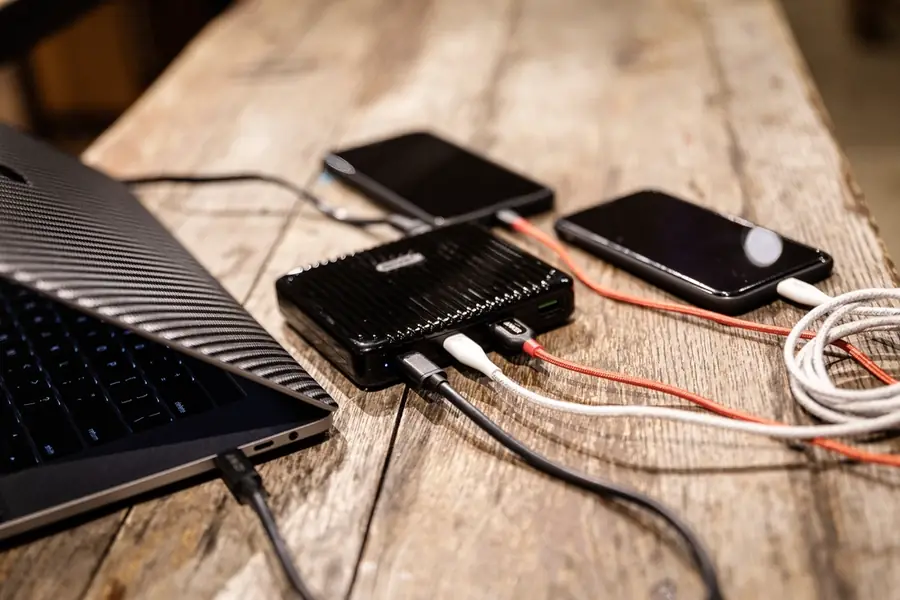
A power bank is invaluable on the move, but in the shop a pile of numbers and brands awaits you. Capacity, watts, USB-C, fast charging. Let us explain what matters and how to choose the right one.
Capacity (mAh)
Capacity in milliamp-hours (mAh) tells you how much energy the power bank holds. As a guide, 10,000 mAh charges an ordinary phone roughly twice, 20,000 mAh several times or also charges a tablet. Note that the real usable capacity is always lower than the number on the box. The power bank’s cells work at around 3.7 V, but the USB output is 5 V and more, and this conversion has its losses. In practice you really get roughly 60 to 70 % of the stated value, so a power bank labelled 10,000 mAh charges a phone more like 1.5 to 2 times, not exactly twice. This is common and normal, not a fault.
Power (watts and fast charging)
The power in watts also matters, as it decides how fast and what it can charge:
- For a phone, lower power and fast charging are enough.
- For a laptop, you need a power bank with USB-C Power Delivery and a power of roughly 60 to 100 W.
Without enough power, the laptop charges slowly or not at all.
Connectors
Today’s standard is USB-C, which serves as both input and output. A larger number of ports is also practical, so you charge several devices at once, possibly also classic USB-A for older cables.
How fast the power bank itself charges
An often overlooked figure. A large power bank with a slow input can take all night to charge. Check the power at which the power bank itself recharges (ideally over USB-C with Power Delivery support), so you have it full again quickly. Pieces that can be charged and charge your phone at the same time are also handy.
What to watch out for
- Capacity versus size and weight. A larger power bank is heavier, choose by what you carry.
- Power by device, one for a phone, another for a laptop.
- Quality and brand. Cheap unbranded pieces tend to be unsafe.
Safety
With power banks, do not save at the expense of safety. Cheap unbranded batteries can overheat or even catch fire. A quality power bank has protections against overheating and overvoltage. Do not leave it in the sun or a hot car.
When flying, an important rule applies: a power bank belongs in carry-on luggage, not checked baggage. Most airlines allow up to 100 Wh without approval, which corresponds to roughly 26,000 to 27,000 mAh. So ordinary 10,000 and 20,000 mAh power banks are fine. The capacity in Wh is usually printed right on the power bank.
What for whom
- A phone: 10,000 mAh with fast charging.
- A tablet or several devices: 20,000 mAh and more ports.
- A laptop: USB-C Power Delivery with a power of 65 to 100 W.
We'll help you choose a power bank
We help you pick a power bank by capacity and power for your devices, and advise on cables and connectors too. For homes and businesses in the Liptov region.
Get advice on your choiceThis article is part of our Hardware and components overview.
Frequently asked questions
Why doesn't a power bank charge as many times as the mAh on the box suggests?
What capacity power bank is enough for a phone?
Can a power bank charge a laptop?
Is a power bank allowed on a plane?
How fast does the power bank itself recharge?
Is it safe to buy a cheap unbranded power bank?
Need help with IT?
We will take care of your computers, networks and security - for businesses and households in the Liptov region.
Contact us