
What people write about our website: four e-mails under the microscope (part 2)
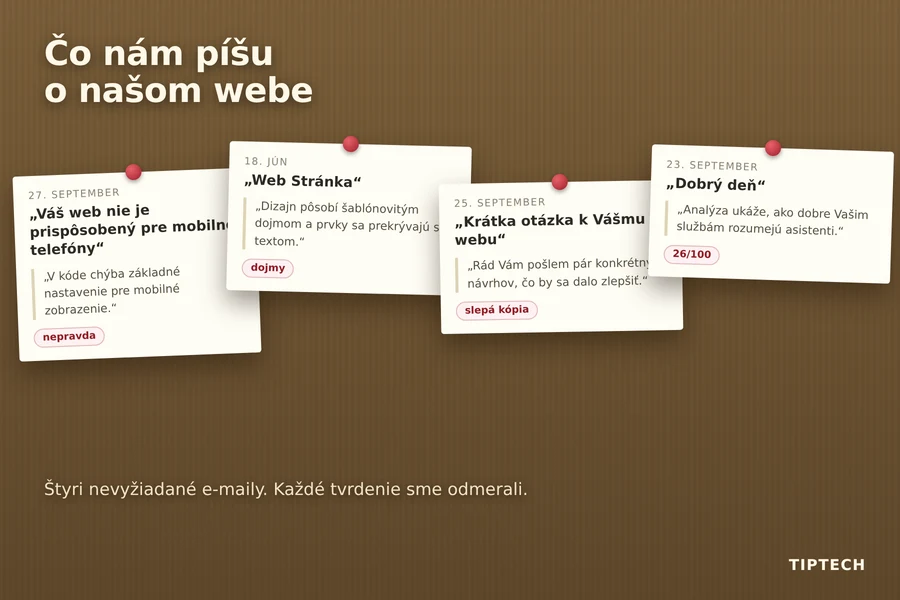
Photo: tiptech.sk (real e-mails from our inbox, anonymised)
In part 1 we wrote about the people who send businesses e-mails about how bad their website is. More have arrived since. So we decided to publish them.
Not for entertainment. We took every message seriously, measured its claims against our own website, and wrote the result underneath. Names, phone numbers and addresses are gone, because this is not about particular people but about the way it is done. We make one exception with the fourth message. That one is not a person but a paid service, and anyone can verify its claims on its own website.
“Good day,
when I went through your website for IT servicing and camera systems in Liptovský Mikuláš, I noticed the page is not technically ready to be displayed on mobile phones. The code is missing the basic setting for mobile display.
For a company dealing in modern technology and security, such a shortcoming can be an obstacle. If a customer is looking for help with a computer or network configuration on their phone, the site may display incorrectly and needlessly lower their trust. It is all the more a pity because on Google you have an excellent 128 ratings averaging 5.0 stars.
To begin with, a technical adjustment of the code setting would be enough. I also noticed that your phone number cannot be dialled from a phone with a single tap. Details like these can either be tuned gradually, or we can build the page entirely anew so that it brings you new enquiries consistently.
If you would like to see websites we have made, the links are below: […]
If you would like to discuss the options for moving your website forward, just reply to this e-mail.”
“Hello,
I recently came across your website and could not help writing to you. I looked at your range of services and I must say that providing complete management and IT support, from computer servicing through network configuration to camera system installation, is absolutely crucial for companies and households these days. In the IT sector customers look for 100% expertise, speed and reliability.
At the same time, while browsing your website on a mobile phone, I noticed one important thing. Since you operate in the technology segment yourselves and offer IT solutions, your website should be the first and strongest proof of your technical competence. The current design and layout, however, feel rather plain and template-like, and at the bottom of the screen elements unfortunately overlap with text, which can disturb visitors and lower the sense of professionalism.
I would like to offer you the creation of a completely new, top-tier website that will reflect your technological level precisely, and into which I will build these modern conveniences:
A smart service and enquiry form […] Premium “Tech” design that builds trust […] 100% optimisation for phones (responsiveness) […] Better search positions (SEO): modern, clean code will make sure people looking for IT servicing in your area find you on Google far more easily and higher than the competition.
You can view my work so far, the level of design and technical execution, directly in my portfolio here: […]”
“Good day,
while going through companies that work in security technology, camera and alarm systems, I came across your company as well.
I build modern websites and it occurred to me whether you have recently considered adjusting your current site or creating a new one.
For companies in your field I believe the important thing is that the website looks trustworthy at first glance, shows services and completed work clearly, and leads the visitor to a call or an enquiry as simply as possible.
Working correctly on mobile, page speed and the basic setup for Google, Google Analytics and Search Console go without saying.
If this is of interest, just reply. I would be glad to send you, with no obligation, a few specific suggestions on what could be improved on your website, along with an approximate price.
Thank you and have a nice day.”
“Good day,
my name is […] and I am writing to you regarding the website tiptech.sk.
In our team (gptsignal.sk) I work with companies in Slovakia that want to find out how well assistants such as ChatGPT, Claude or Gemini understand their services.
I think the analysis could be useful for your website too. It will show which information is recognised and what would be worth explaining more clearly.
You can run the analysis here: […]”
The fourth case: a test that does not rate your website
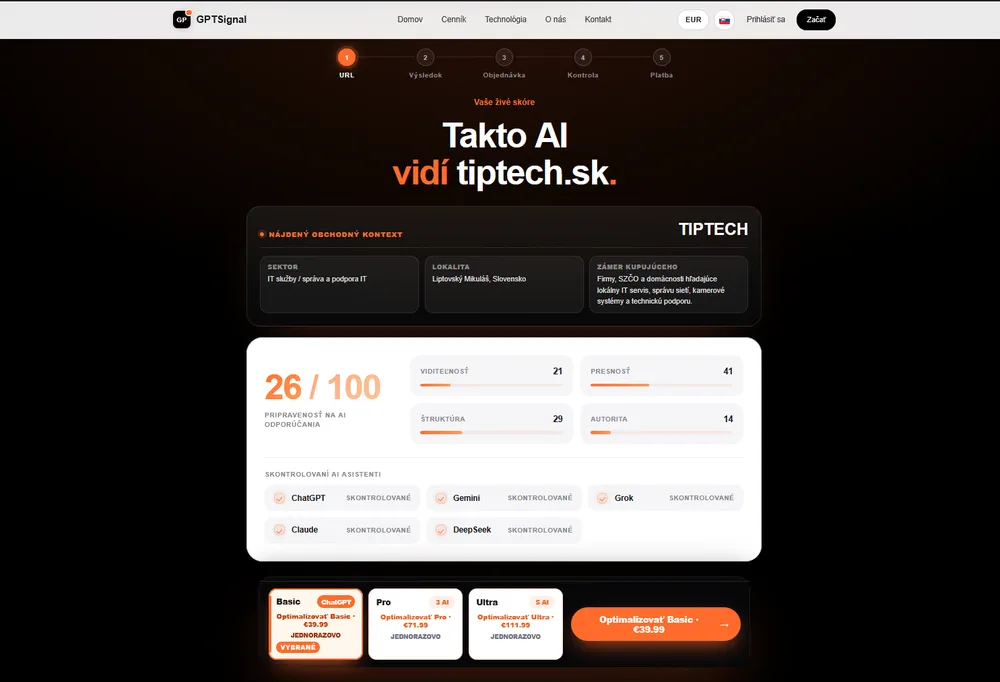
The last message is different. It claims nothing specific about our site, it only offers to run an analysis showing how well language models understand our services. The link leads to a service called gptsignal.sk. We ran the test.
The result was 26 points out of 100, and right below it three packages at 39.99, 71.99 and 111.99 euro.
It does not measure what you think
The key thing you will not learn from the e-mail is written on their own Technology page. Their probes ask assistants through public interfaces, roughly 600 questions across five assistants. They never fetch your website at all.
That means the result says nothing about the state of your page. It says what language models happen to remember about your company, in other words brand awareness. The e-mail, however, presents it as an analysis that will show what is worth explaining more clearly on your website. Those are two entirely different things.
We tried it on two well known websites
To find out what the number means, we ran the same test on two websites that need no introduction.
| Website | Score | Visibility | Accuracy | Structure | Authority |
|---|---|---|---|---|---|
| Wikipedia | 98 | 98 | 99 | 99 | 96 |
| Martinus, the largest Slovak bookstore | 25 | 27 | 44 | 11 | 11 |
| tiptech.sk | 26 | 21 | 41 | 29 | 14 |
So no, it is not a tool that hands everyone a bad number. Wikipedia scored 98. But Martinus, one of the best known Slovak brands with millions of customers, got 25, practically the same as a small IT service shop from Liptov. If the test cannot tell those two apart, it says nothing usable about a local company.
What you will not be told
- The methodology is not published. The score has four components, but nowhere is it explained how they are calculated.
- There is no Slovak company behind it. The terms and conditions name ULTEH LLC. Neither the About nor the Contact page carries a single identifying detail, no company number and no registered address, although the domain is Slovak.
- The prices contradict each other. The test offers packages from 39.99 to 111.99 euro, while their own site advertises a package at 49.99.
- And one more thing. Across four pages of this service we counted 72 long dashes. That is exactly the sign we described in part 1 as the most reliable trace of text nobody read after the AI.
We are not claiming this is a scam. It is sales. You just need to realise that the number does not measure your website, and that you would be paying to improve it to a company whose address you never get to learn.
What we actually measured on our own site
So that this is not only about their claims, we measured our own website. Four pages, six screen widths from 320 to 1920 points, plus the contents of the code.
| What we measured | Claim in the e-mail | Reality |
|---|---|---|
| Mobile display setting | missing | present on every page |
| Clickable phone number | does not work | two links on the home page |
| Layout breaking on narrow screens | broken on mobile | none, from 320 to 1920 points |
| Errors in the page code | technically unprepared | zero |
| Server response | not mentioned | under 20 ms |
| Home page size | not mentioned | 0.25 MB |
The one thing none of them found
The same measurement turned up something that genuinely bothered us. The blog listing downloaded the thumbnails of every article at once, 4.4 megabytes in two hundred and fifty requests. On mobile data that was needlessly heavy.
We fixed it the same day. Thumbnails now load only as you scroll near them.
| Blog listing on mobile | Before | Now |
|---|---|---|
| Data transferred | 4.45 MB | 0.18 MB |
| Number of requests | 250 | 21 |
That is twenty five times less data. And this is the whole difference. You find a real weakness by measuring, not by a sentence someone mailed to hundreds of companies at once.
How to check these messages yourself
You do not need to be technical. Three things are enough, each under a minute.
- Look at the page source. Press Ctrl+U in the browser and search for the word viewport. If it is there, the claim about not being ready for phones falls apart.
- Look at the e-mail headers. In Gmail use Show original, in Outlook use Message properties. The name of a mailing service in the return path, or hidden recipients, means the message was not written for you.
- Open the sender’s own website. On a small screen too. If someone sells websites, their own website is the work sample. A free subdomain instead of an own domain says everything.
If you want hard numbers, put your address into Google PageSpeed Insights. It is free and within a minute you know where you stand. What a quality website should meet is covered in what a quality website should look like in 2026.
Conclusion
Four messages, four different senders, one pattern. The specific technical claims fell apart once checked, the rest were impressions, an offer to send specifics only after you reply, or a number from a test that never opens your website. Not one of them found the only thing on our site that was actually worth fixing.
This does not mean e-mail offers should never be trusted. It means you can verify a claim about your website before you pay for it. And when someone tells you something you can disprove in half a minute, you already know how much work went into the rest.
Want to know how your website is really doing?
We look at it with human eyes, test it with professional tools and tell you straight what is worth changing and what is not. No bulk e-mails.
I want an independent viewThis article is part of our Business and IT overview.
Frequently asked questions
I got an offer saying my website is not mobile friendly. How do I check it myself?
How do I recognise that an offer for a new website is bulk mail not meant for me?
Is it true that without a clickable phone number I lose customers?
The sender had a portfolio in the signature. What should I look for?
Does this mean every e-mail offer is a scam?
I got a low score in an AI visibility test. Does it mean my website is bad?
How do I get my site reviewed when I do not trust these offers?
Need help with IT?
We will take care of your computers, networks and security - for businesses and households in the Liptov region.
Contact us