
Delidding a CPU: what a delid is and why it is playing with fire
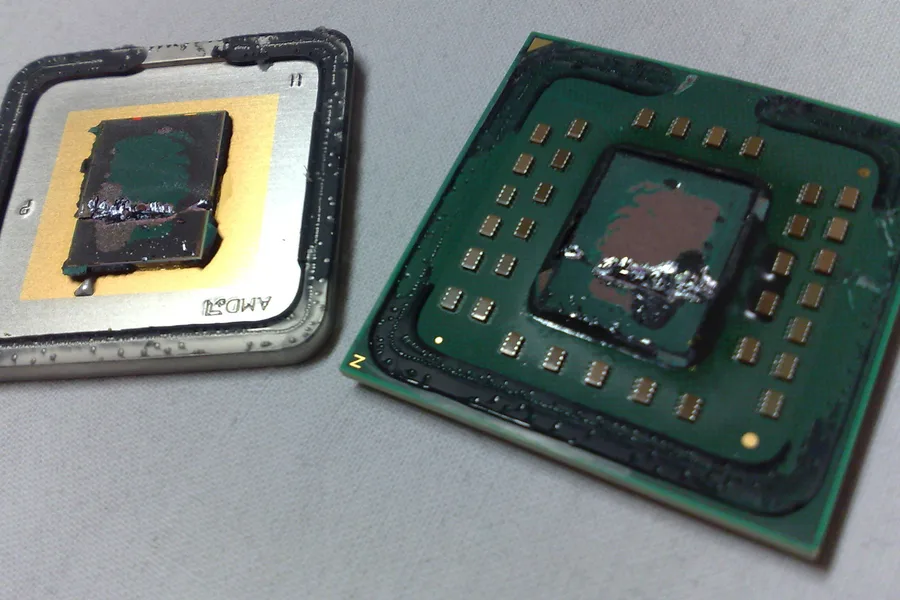
Delidding is one of those things the enthusiast community talks about with respect and dread at the same time. It promises lower temperatures and higher performance, at a price that can be a whole CPU. This article explains what a delid is, why people do it and why it is a procedure only for those who know exactly what they are getting into.
What a delid is
On top of the CPU sits a metal plate, the IHS (Integrated Heat Spreader). It protects the fragile silicon die under it and at the same time spreads heat into the cooler. Between this lid and the die is a thin thermal layer, so heat passes from the die into the lid.
Delidding (from delid, to take the lid off) means separating this lid from the die. There is only one reason: to reach that layer between the die and the lid and replace it with something that carries heat better. Most often with liquid metal. The lid is then either glued back on, or left off so the cooler sits straight on the die.
Why enthusiasts do it
The key is what sits under the lid from the factory. There are two options:
- Solder. The die and the lid are joined with metal solder, which carries heat excellently. Such CPUs hardly need a delid, the difference would be small.
- Thermal paste. Under the lid is ordinary paste, cheaper to produce but worse at carrying heat. On top of that it dries out over time. It is exactly on these CPUs that a delid and a switch to liquid metal can cut temperatures under load by 10 to 20 degrees.
A lower temperature means the CPU holds its highest clocks longer and throttles less. With extreme overclocking it is sometimes the only way to reach the last bit of performance. That is why delidding belongs mainly to the world of competitive overclocking and the most powerful builds, not to an everyday computer.
Why it is playing with fire
Delidding is irreversible and dangerous from several sides at once:
| Risk | What can happen |
|---|---|
| Mechanical damage | While prying or in the delid tool the die can crack or a corner can chip off. Then the CPU is dead. |
| Liquid metal | It conducts electricity and eats aluminium. A drop on the pins or on the board shorts or destroys a part. |
| Loss of warranty | The manufacturer treats a delid as unauthorised tampering. After it, a claim is no longer accepted. |
| Direct die | Without the lid the bare die is extremely fragile and needs a special bracket, or the cooler’s pressure crushes it. |
On top of that you need a delid tool made exactly for that type of CPU, experience and steady nerves. It is not a procedure worth trying just for fun on a CPU you use every day.
How it looks today
Delidding used to be a hot topic, because several CPU generations had paste under the lid and the difference after a delid was large. Today the picture is mixed. Some modern CPUs are soldered, so a delid gives them little. Others, especially the most powerful models that stay hot even with a good cooler, are still a target for enthusiasts who get lower numbers out of them with a delid and liquid metal.
For completeness: there is also a safer cousin, where the lid is not removed and only the thermal paste on top, between the lid and the cooler, is replaced. That has nothing to do with a delid, it is routine maintenance with no risk and helps in most cases where a CPU overheats.
The sensible route to lower temperatures
If high temperatures bother you, a delid is the last and riskiest option. Before you even think of it, it is worth going through the safe steps:
- A good cooler matched to the CPU’s power. More in the article on how to choose CPU cooling.
- Good airflow in the case and a clean, dust free interior.
- Fresh thermal paste between the CPU lid and the cooler.
- Watching temperatures, so you know what is really going on. We covered how in the article on monitoring CPU and GPU temperatures.
If even after these steps the CPU crashes or overheats under load, the cause is usually elsewhere, for example in the motherboard’s power delivery. That is worth checking before a delid.
Is your computer overheating or crashing under load?
We measure the temperatures, assess the cooling and the power delivery and propose a safe solution, from replacing the thermal paste to better airflow. In person in Liptov, remotely elsewhere.
I want adviceThis article is part of our Hardware and components overview.
Frequently asked questions
What does delidding a CPU mean?
How many degrees does a delid save?
Is delidding safe?
Why do some CPUs have paste under the lid instead of solder?
What is direct die cooling?
Is a delid worth it for an ordinary user?
Need help with IT?
We will take care of your computers, networks and security - for businesses and households in the Liptov region.
Contact us