
Have you heard of the domain name scam? This is what an email from a “Chinese domain registry” looks like
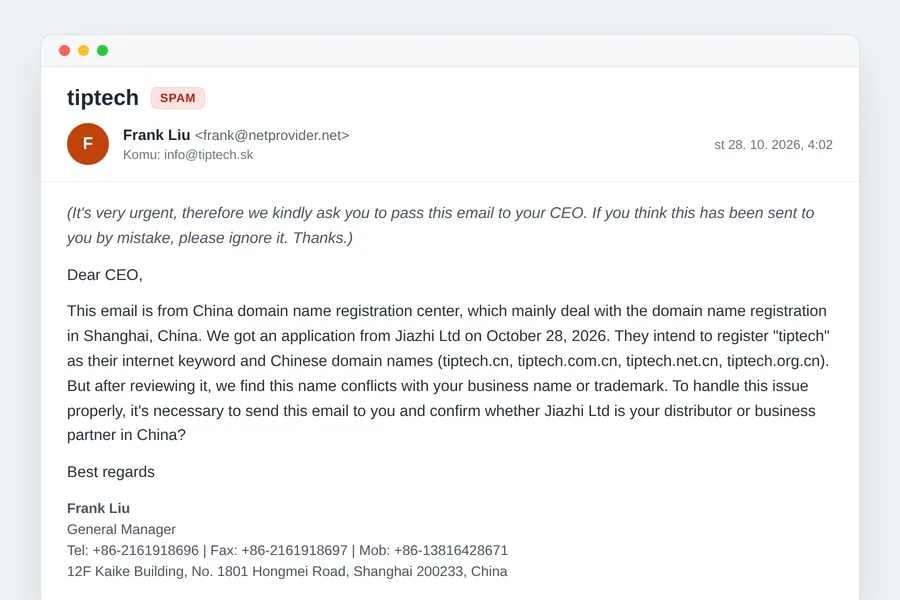
The email as it arrived on 28 October 2026. Our mail filter flagged it as spam on its own.
Early in the morning of 28 October, an email arrived at our company address info@tiptech.sk with the one-word subject “tiptech”. The sender: Frank Liu, general manager of some Chinese domain name registration centre. The very first sentence asks us to pass the message to our CEO because it is very urgent.
It sounds proper, almost considerate. Someone wants to take your name, and the registry kindly warns you about it. But it is a domain name scam, one of the oldest frauds on the internet. The Swiss Federal Institute of Intellectual Property warned about it as early as 2012, and the emails keep coming to this day, just with different names.
What they want from you
No company called Jiazhi Ltd wants to register your name. Often it does not even exist. The whole email has a single goal: to scare you into thinking you will lose your name in China and to sell you domains you do not need.
If you reply that you do not know the company and authorised nothing, the “registry” generously offers to register the domains for you instead. There is a catch. The price is usually several times higher than what the same domain costs at an ordinary registrar, and typically for five or ten years at once. The US law firm Harris Sliwoski, which focuses on Chinese law, reports that companies that accepted such an offer paid between 500 and 3,500 dollars. For domains that would otherwise cost a few euros a year, or that they did not need at all.
The German regional chamber of commerce Bergische IHK puts it briefly: in most cases it is an attempt to win a customer, and the sender often has no authority to register domains at all. Whether any application ever existed is usually doubtful.
How we verified it
We did not want to rely on “everybody knows”. We checked this particular email.
The domains someone supposedly wants to register were taken long ago. We checked all four addresses from the email in the Chinese domain registry (CNNIC). The domain tiptech.cn has been registered since 31 January 2006 and tiptech.com.cn since 7 September 2005. Both have completely different owners who have nothing to do with us or with any Jiazhi Ltd. Nobody can “register” them on 28 October 2026, because they have belonged to someone for almost twenty years. No real registry would write such a message. The text is a template into which the scammer simply inserts your company name.
The email did not come from Shanghai. The message headers show where it actually came from. The server mx.cnname.net that sent it has an IP address belonging to FranTech Solutions, a US provider of cheap virtual servers. The domain cnname.net was created on 11 July 2026 and the sender’s domain netprovider.net in August 2025. Neither belongs to any authority or registry.
SPF and DKIM passed, and it is still a scam. This confuses people a lot, so we want to stress it. SPF and DKIM only verify that the message was sent by a server the sender’s domain allows. The scammer registered their own domain and set it up correctly, so technically everything is in order. These checks say nothing about whether the content is true. We cover them in more detail in our article on securing company email with SPF, DKIM and DMARC.
Our mail filter caught it on its own. The message got a score of 11.2 and was flagged as spam. Not every filter is that strict, though, and similar emails do land in inboxes.
How to recognise a domain name scam
- “Dear CEO” or “Dear President” and a request to forward the message to management. The sender does not know who they are writing to and wants to reach the person who decides about money.
- Urgency. “Very urgent”, in other versions a deadline of seven working days after which they will “unconditionally finish” the registration.
- A registry that protects you without being asked. Domains are generally assigned to whoever comes first. Registrars do not check other people’s trademarks and do not write to their owners. If someone really registered your name, you would find out afterwards, not in advance by email.
- An unknown company with an unknown name. Jiazhi Ltd, other times Huaya Holdings or another name. It changes depending on who they are writing to.
We dissected the same pattern in different packaging in emails that threaten to delete your domain. There, too, the point was to make you act before you ask anyone.
What to do with such an email
Do not reply and do not call the numbers listed. A reply only confirms that the address is live and someone reads it, and you will get an offer for expensive domains.
Mark it as spam and delete it. You do not need to explain anything to anyone or prove that you do not know Jiazhi Ltd.
If you really do business in China, register .cn domains yourself with an accredited registrar you choose. The Chinese registry CNNIC publishes the list of accredited registrars. Never with whoever contacted you. Brand protection in China is handled by a trademark, not domains, and it is worth talking to a lawyer about it.
Check that your own domains are in order. A much bigger risk than a Chinese domain is that your own .sk domain expires because the invoice ended up in spam or nobody reads the contact address any more. We explain how it works with registrars in Domain registrars and expired domains.
Received a similar email and not sure about it?
Send it to us. We will look at the headers and at the domains it mentions and tell you what is true. We can also help put your domains and company email settings in order.
Get in touchVerification and sources. Based on an email delivered to info@tiptech.sk on 28 October 2026. We verified the owners and registration dates of the .cn domains in the CNNIC registry, the sender’s domains in the public domain registry and the owner of the IP address in the ARIN registry. We did not reply to the email. Warnings: Swiss Federal Institute of Intellectual Property (IPI), Bergische IHK Wuppertal-Solingen-Remscheid, Harris Sliwoski.
This article is part of the Cybersecurity overview.
Comments and questions 0
We keep the discussion to the point. Ads, links to other services, profanity and personal attacks will not be published. Neither will posts containing other people's personal data.
Frequently asked questions
I got an email saying a Chinese company wants to register my name as a .cn domain. Is it true?
What happens if I reply to such an email?
How did we find out that the tiptech.cn email was a scam?
The email passed SPF and DKIM checks. Does that not mean it is genuine?
Should I register .cn domains myself just in case?
I already replied or paid. What now?
Need help with IT?
We will take care of your computers, networks and security - for businesses and households in the Liptov region.
Contact us