
Why Google is indexing fewer websites and what to do about it
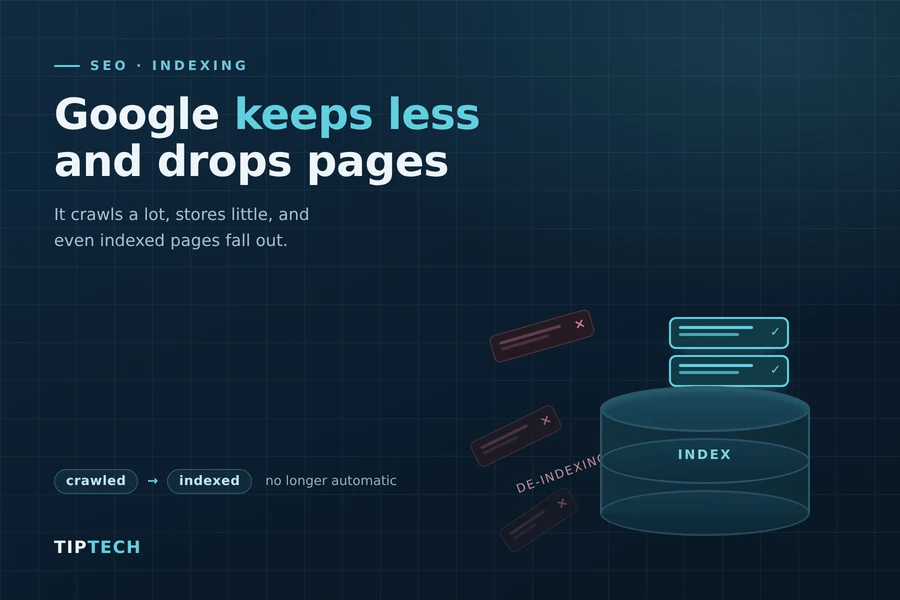
Illustration: tiptech.sk
Being online no longer means being found. And worse, being found once no longer means being found for good. More and more site owners discover that their pages are not in Google, or that pages which had sat there for years have vanished. The site works and Google visits it. This is not a malfunction. It is a change in how Google decides what to remember at all, and what to keep.
Crawling and indexing are not the same thing
This is the heart of the problem, and most people merge the two. They are in fact two separate decisions.
Crawling is when Google’s robot downloads your page and reads its content. Indexing is when Google decides to store that page in its database and show it in search results. The first does not imply the second.
Google’s John Mueller says it openly and repeatedly: when we crawl something, it does not automatically mean we will index it. Google now crawls far more URLs than it plans to index. It discovers your page, looks at it, and then decides whether storing it is worth it at all. And it does not make that decision only once.
The index is not a vault: Google drops pages too
This is the part that catches many people off guard. Being indexed is not a permanent state. Google re-evaluates its index continuously, and whatever stops meeting its bar falls out, often with no notice in Search Console. One day a page is searchable, a month later it is not, and nothing on it changed.
Since spring 2026 this effect has grown much louder. In late April, former Google employee Pedro Dias publicly asked whether others were also seeing Google remove URLs from the index at a higher rate since the start of the month. Over the following weeks, hundreds of site owners and SEO specialists reported the same experience. It was not only individual URLs. Some sites reported that entire sections flipped into the Crawled, currently not indexed status, in extreme cases practically the whole site, which had been indexed for as long as six years.
Google officially states that it sees nothing unusual and that this is ordinary, quality-driven selection, not a bug. Both claims can hold at once. From Google’s side it is normal, continuous index housekeeping. From the site owner’s side it is a real loss of traffic that nobody reported.
SEO analysts who tracked this wave noticed one recurring pattern: pages that have not changed and that Google has not actually crawled for a long time are more likely to drop out. Put simply, content that feels parked and lifeless has a smaller chance of staying in the index. Steady traffic and signals that a page still interests someone help.
The quality signal applies to the whole site, not just the page
This is the insight that separates an amateur view of SEO from a professional one. Google has confirmed that when it doubts a site’s overall quality, it crawls and indexes less of it. In other words, the judgement happens not only at the level of a single page, but at the level of the whole domain.
The consequence is uncomfortable but logical. If a site has dozens of weak, empty or generated pages, Google may lower its trust in the site as a whole and stop properly indexing even the good pages that would stand on their own. Weak pages therefore do not only harm themselves, they drag the whole site down. The reverse is true too, and that is the good news: when you remove or merge the weak pages, the quality of the whole rises and Google often starts indexing what remains better.
What exactly you see in Search Console
The free Google Search Console is the only place where you see Google’s decisions directly. In the Pages report you will find two statuses that describe what is happening.
- Crawled, currently not indexed. Google downloaded the page, saw the content, but decided not to include it, or removed it. It judged it as not valuable enough. This is exactly where previously indexed pages now fall.
- Discovered, currently not indexed. Google knows about the URL but did not even bother downloading it. It did not consider it important enough to spend crawl budget on.
Neither status is a bug in your code. It is a verdict. What matters is to watch not only the current number but its trend over time. When the count of not-indexed pages grows month after month, the site is losing visibility and you may not otherwise know.
Why Google is suddenly saving space
The old rule was simple: publish a page and Google will index and keep it sooner or later. That is over, and there are several reasons.
The flood of AI-generated content. When anyone can produce thousands of pages that look like real content in a few minutes, Google would bury its own index in emptiness. It has no reason to store ten versions of the same idea, nor the capacity to pay for storing everything anyone generates. So it raised the bar and admits mainly what has clear added value.
Economics. Every stored and continuously served page costs Google storage and compute. When the volume of content online grows faster than its quality, it is logical to stop storing everything and start choosing.
A moving bar. The quality threshold is not fixed. With every major core update of search, it can move higher, and a page that still cleared the bar last year may no longer clear it today. That is why de-indexing often lines up with periods of larger updates.
SEO analysts observe that sites have a smaller share of their pages in the index than a few years ago. No one will give you an exact figure, because Google does not publish it and it differs from site to site. But the trend is clear: Google’s index is becoming pickier, and it keeps what it admits for a shorter time.
Who this affects
The good news for small businesses is that this usually does not hit them badly. A site of a few honest pages that really says something about the company and its services, and gets refreshed now and then, gets indexed and stays without trouble.
The sites in trouble are those that bet on quantity instead of value:
- dozens of near-identical pages where only the town or product name changes,
- empty or near-empty categories and tags that contain nothing,
- orphan pages that no internal link on the site points to,
- mass-generated text with no specific facts and no added value,
- duplicate content repeated across several URLs.
These are exactly the pages now only partly indexed, and the first to drop out. And that is precisely why we warned in another article about instant web developers who build you a site full of empty, generated pages. Such a site exists, but Google largely ignores it and gradually lets it fall from the index.
How to check where you stand
You do not have to guess, it can be verified in a few minutes.
- Google Search Console, the Pages report. It shows exact numbers: how many URLs are indexed, how many are not, and why. Watch the trend above all. A rising curve of not-indexed pages is a warning sign.
- URL Inspection. In the same console you enter a specific URL and Google tells you whether it is indexed, when it was last crawled, and if not, why.
- A quick estimate through search. Type
site:yourdomain.cominto Google and see roughly how many of your pages are listed. When that number is far lower than the number of pages the site really has, you know part of it is not indexed. - Server logs (for the advanced). Web server logs reveal how often and which pages Google’s robot actually crawls. Pages it has not crawled for months are the first candidates to drop out of the index.
What to do about it
Indexing is not a right, it is a consequence of quality. So the fix is not some trick, it is work on substance, in order of impact:
Raise the quality of the whole site, not just one page. Because Google judges trust in the domain as a whole, removing the dead weight usually has the biggest effect. Delete or merge thin, empty and duplicate pages. Paradoxically, fewer pages often means more indexed content, because the quality of the whole rises.
Give every page a reason to exist. If a page offers nothing that is not already better elsewhere, Google will neither include nor keep it. Each one should answer a specific question or cover a specific topic with its own value.
Connect the site with internal links. A page nothing on the site links to looks unimportant and is the first to go. Meaningful links between pages help Google understand what matters and push trust deeper into the site.
Keep content alive. Since parked, long-uncrawled pages are more vulnerable, it helps to extend and update important pages over time. Not cosmetic edits, real improvements.
Keep the technical side tidy. Correct canonical URLs, an honest noindex tag on what truly does not belong in the index, a working sitemap and clean URL structure make it easier for Google to navigate. They do not replace quality, but they direct it properly.
Build authority. Links from other trustworthy sites and a real reputation raise trust in the domain, and with it Google’s willingness to index the site and keep it.
Be patient. Even when everything is fine, a page sometimes sits in the not-indexed state for a while and returns to the index with a delay. If it has real value and the site earns trust, it usually resolves over time.
All of this ties into how SEO is done honestly today. A full overview is in our article on how to maximise SEO, the power of links is covered in our article on backlinks, and what a quality website should meet is covered here.
Conclusion
Google did not stop indexing websites, it started choosing and tidying up as it goes. Crawling and indexing are two decisions, the index is not permanent storage, and since spring 2026 even pages that sat there for years have been dropping out. The main cause is the flood of AI-generated content and the rising quality bar that comes with it, while Google judges the trust of a site as a whole. Being online is no longer enough, a page has to earn its place in the index and then hold it through value. Check in Search Console how many of your pages are really listed and where it is heading, and prefer fewer honest pages over many empty ones. If you are not sure what to do, get in touch and we will look at it.
Missing from Google, or disappearing from it?
We check how many of your pages are really in the index and where it is heading, find what Google objects to, and propose what to fix. For homes and businesses in Liptov, remotely elsewhere.
Get in touchSources and verification. You can check your own site’s indexing status in the free Google Search Console. How Google explains crawling and indexing and what each status means is in the official Google Search Central documentation. The site-wide quality point has been confirmed repeatedly by Google’s John Mueller, and the spring 2026 wave of increased de-indexing was documented by specialist SEO media.
This article is part of our Business and IT overview.
Comments and questions 0
We keep the discussion to the point. Ads, links to other services, profanity and personal attacks will not be published. Neither will posts containing other people's personal data.
Frequently asked questions
Why does Google not index my pages even though it crawls them?
Why did a page that had been in Google for years disappear?
What does Crawled, currently not indexed mean in Search Console?
Why did Google tighten indexing right now?
How do I find out how many of my pages are really in Google?
How do I get Google to index my pages and keep them?
Need help with IT?
We will take care of your computers, networks and security - for businesses and households in the Liptov region.
Contact us