
“Your website is not responsive”: who the people sending these e-mails are, and why not to trust them with your site (part 1)
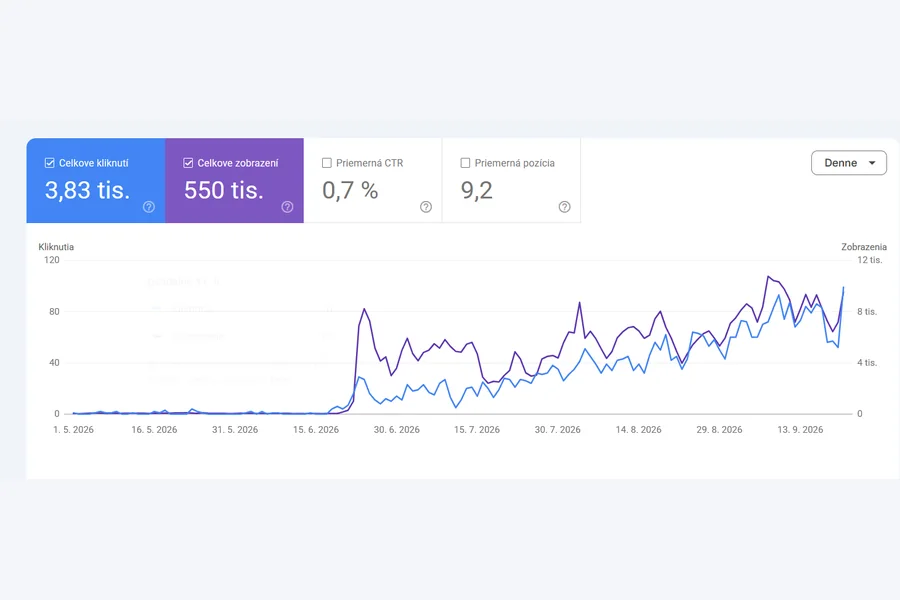
Photo: tiptech.sk (Google Search Console, May to September 2026)
For the past few months, our inbox and our customers’ inboxes have been filling up with offers to “fix our website”. They come in two forms and both end the same way: your website is bad and we will put it right for a fee. We took a closer look at who sends them and what is behind them.
Form one: the e-mail “your website is not responsive”
The message opens with a description of our company and what we do, continues with how important a quality, responsive website is today, and ends with the finding that ours is in bad shape: not responsive, weak SEO, technically unsound. And at the end, an offer: we will fix it for you.
Look at these messages more closely and most of the text is generated by AI. The sender could not be bothered to write a few sentences by hand, let alone open your website and look at it with human eyes. The same message goes out to hundreds of companies in the area at once, only the name in the first sentence changes. Where is the respect for the customer in that? Someone who wants to sell you care for your shop window on the internet has not even looked at it.
We opened their websites
The first thing we click when such an e-mail arrives is the website of the person writing to us. And guess what? Every single one was generated by AI.
Case one. A gentleman wrote that our site was not responsive and had weak SEO. His own site froze, the responsive layout did not work and on a small screen some sections rendered completely broken. And to top it off, he did not even have his own domain. His presentation ran on a third party’s free hosting, with a foreign address in the browser bar. Tell us honestly, would you want a website from this person?
Case two. Slightly less entertaining, but instructive. A gentleman e-mailed us about how important it is to optimise a website and that ours needed it. We called him and asked him to walk us through what exactly he would change on our site. After a moment he admitted there was actually nothing to change. That it was fine.
Form two: the “checker” that always gives a bad result
A newer and more cunning version of the same offer. A link arrives to a Slovak “website checker” that promises to verify how well your site is understood by ChatGPT, Gemini, Claude, DeepSeek or Grok. You enter the address, wait, and get a score. A low one. The vast majority of websites get a very low rating from it, including sites that Google PageSpeed Insights, a tool with real authority, gives full marks for performance, accessibility and SEO basics.
What the tool actually measures, you never learn. There is no methodology. What you do get, right under the bad result, is an offer to optimise your website. It is not a measurement, it is a sales funnel: first it scares you with a number, then it sells you the cure. An interesting way of winning business, would you not say?
The common denominator of both forms is the same: a verdict on your website without anyone looking at it, followed immediately by an invoice.
AI is not the problem. The problem is who is holding it
Do not read this as AI being a bad thing. It is an excellent tool, we all use it and it helps us a great deal too. Just as a calculator helps with arithmetic, AI helps with other tasks. But you have to know how to tame it.
That is why so many websites today look the same and unprofessional. You spot them at first glance by a few signs.
Long dashes in every other sentence. Probably the most reliable sign of text nobody read after the AI. The long dash, the em dash, is the “—” character, twice as long as an ordinary hyphen “-”. It cannot be typed with a single key press and most people never use it. Language models, however, love it and put it wherever a person would write a comma, a colon or a full stop. A typical sentence from such a website:
We build websites — modern, fast and secure — that deliver results — without compromise.
A person would write it like this: “We build modern, fast and secure websites that deliver results.”
A coloured blinking dot right above the main heading. A small pulsing dot in a rounded pill saying “Accepting new projects” or “Available”. It comes from the default template the tools generate sites from and has no place on a real company website. Below it there is usually a heading with a colour gradient and a phrase about the future or innovation. This is what it looks like:
Notice that this header says nothing about the company. No town, no price, no name, no actual website you could open.
Other signs:
- the same template, the same hero sections, the same phrases about innovation and tailored solutions,
- no specific facts, prices, names or references,
- a broken layout on small screens, even though the copy promises responsiveness.
And above all: someone is pushing a service on you that, first, they have not mastered themselves, second, they have no infrastructure for, third, they lack the IT and networking knowledge for, and fourth, they lie to you in the very first message, because they never looked at your site. Do not trust such people with your website. The only result will be that they take your money and the AI rebuilds the site only as far as it can on its own. Roughly 40 percent of the work that only a professional can do will still be missing: security, hosting, backups, e-mail, performance, measurement.
How to vet a supplier
You will be approached by hundreds of instant web developers who a year ago did not even expect to end up in the IT sector and now want to optimise the websites of every company in the area. Security, care, support and everything else will be left hanging in the air. So we always recommend:
- Look at their website. On a small screen as well. If it is slow, broken or on someone else’s domain, read no further.
- Call them. Have them tell you within two minutes what exactly they would change on your site and why. Anyone who has not looked cannot answer.
- Check the company. Business register, trade register, how long it has existed, whether it has references you can open live.
- Check the reviews. Choose wisely. Writing a few fake reviews on your own website is no trouble at all. Look for Google reviews that can be verified, and feel free to call one of the clients from the references.
- Ask about operations. Where the site will be hosted, who does backups and updates, who handles security, what happens when the site goes down on a Saturday evening.
- Measure it yourself. Google PageSpeed Insights is free and tells you in a minute how your site really performs. What a good website should meet is in our article what a quality website should look like in 2026.
What real optimisation looks like
To close, here is a real chart from Search Console for one of our websites. From mid June, when we deployed content and technical optimisation on it, including preparation for AI-driven search, it grew from zero to 550 thousand impressions and 3,830 clicks from Google in four months.
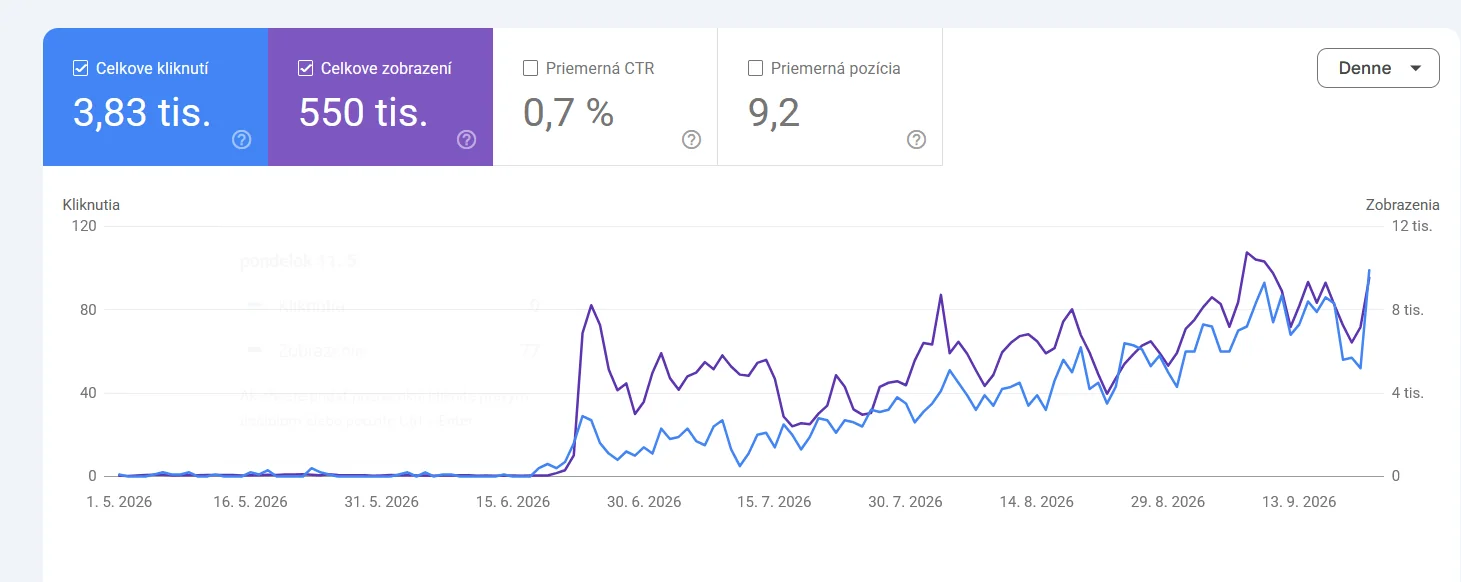
The difference from the instant web shops is not that we avoid AI. It is that the site is also secure, fast, hosted on infrastructure we run ourselves, and looks professional because a person always finished it after the tools. How to do SEO honestly is in our article how to maximise SEO, and when AI is a good servant and when a bad master is covered here.
Conclusion
An e-mail telling you your website is not responsive is today almost always a bulk message written by AI from someone who never looked at your site and whose own site is worse than yours. Pay them nothing before you open their website, call them and check their company. PageSpeed Insights shows you the real state of your site in a minute. And if you need a website that is not just pretty but also secure and grows in search, get in touch.
Want to know how your website is really doing?
We look at it with human eyes, test it with professional tools and tell you straight what is worth changing and what is not. No bulk e-mails.
I want an independent viewContinued (part 2): the real e-mails that arrived since, with every claim checked, are on our What people write about our website.
This article is part of our Business and IT overview.
Frequently asked questions
I got an e-mail saying my website is not responsive and has weak SEO. Is it true?
How do I check whether a website optimisation offer is serious?
What is an AI website checker that rates how well ChatGPT or Gemini understand my site?
How do I recognise a website generated by AI without human work?
Is it bad if a web developer uses AI?
How do I vet a company before trusting it with my website?
Need help with IT?
We will take care of your computers, networks and security - for businesses and households in the Liptov region.
Contact us