
Adapter power on paper versus real: how it is measured
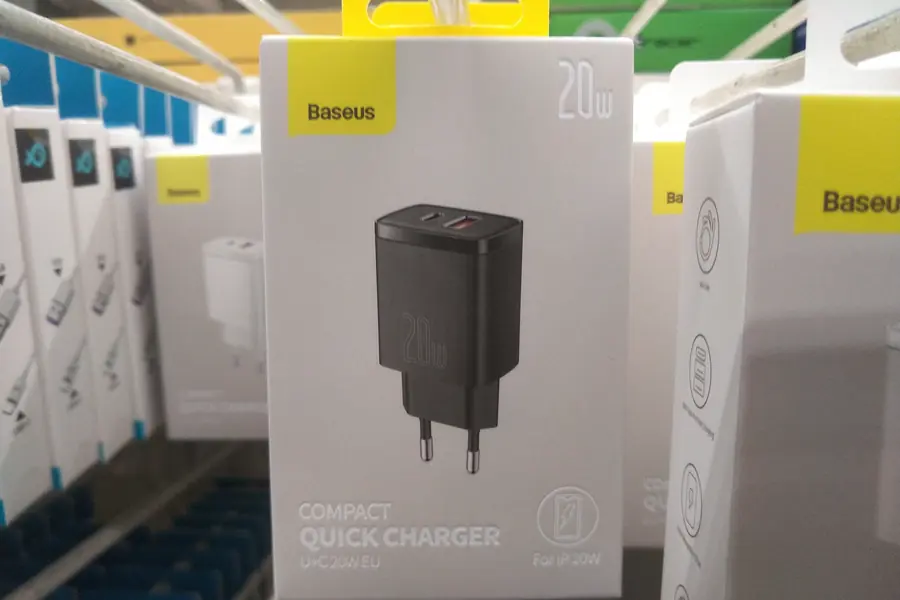
A charger has a power rating in watts written on it, but how much does it really deliver? Similar to battery capacity, here too the paper value and reality can differ. Let us explain what the numbers mean, why a difference arises and how real power can be precisely measured.
What V, A and W mean
On an adapter we see three figures that relate to each other:
- V (volts) is voltage.
- A (amps) is current.
- W (watts) is power, and a simple relationship holds: power (W) = voltage (V) times current (A).
A charger rated 5 V and 2 A therefore delivers 10 W. With modern fast chargers the voltage and current change according to the device, which is why they have several combinations.
Why declared and real power differ
The number on the adapter is the maximum under ideal conditions. In practice the delivered power tends to be lower:
- Efficiency is not one hundred percent. Part of the energy turns into heat, which is why a charger warms up.
- A drop under load. Cheap adapters dip slightly in voltage at full draw, and thus in power too.
- The cable and connector. A thin or long cable causes loss, so less reaches the device than the adapter gives.
- Overstated numbers. Some cheap chargers declare power they cannot really handle, which can also be a safety risk.
So it can happen that a device charges more slowly than the rating suggests.
How real power can be measured
Here too the good news holds: the real delivered power can be precisely measured. A load tester (power load tester) serves this purpose, simulating a device’s draw and measuring what the adapter really delivers.
- The device sets a controlled load and measures voltage and current in real time.
- It shows the real power in watts at various draws.
- It reveals the voltage drop under load and whether the adapter handles the declared value.
This way you can verify whether the charger delivers what it promises and whether it is safe. With cables, it also shows how much energy the cable itself eats.
When measuring is useful
- When buying a charger or power bank, to check it really delivers the declared power.
- When a device charges suspiciously slowly.
- With a cheap or no-name charger, for power and safety.
- When choosing a cable that must not be a bottleneck.
Related topics are in the articles on how to choose a phone charger and how to choose a laptop charger. On measuring battery capacity there is a separate article on battery capacity: declared versus real.
Conclusion
The power on an adapter is a paper maximum. The actually delivered power tends to be lower due to efficiency, a drop under load and cable losses, and on cheap units it can also be overstated. The real value, however, can be precisely measured, and so you can reliably judge whether a charger is worth it.
Want to verify your charger's real power?
We will precisely measure the delivered power and safety of the adapter and compare it with the declared value. For homes and businesses in the Liptov region.
Book a measurementThis article is part of our Hardware and components overview.
Frequently asked questions
Why does a charger not really deliver as many watts as stated?
How are volts, amps and watts related on a charger?
How can the real power of a charger be measured?
Can a cheap charger be dangerous?
Can the cable itself cause slow charging?
When is it worth measuring an adapter's real power?
Need help with IT?
We will take care of your computers, networks and security - for businesses and households in the Liptov region.
Contact us